Cover Rules in D&D 5e: Half, Three-Quarters, and Total Cover Explained (2024)
A goblin archer ducks behind a low stone wall. A player asks, "so does it get the +2, or the +5?" Cover is one of the most-used rules in 5e combat and one of the most fudged. Here is exactly how it works in the 2024 ruleset, quoted from the rulebook, with every edge case that actually comes up at the table.
The quick answer
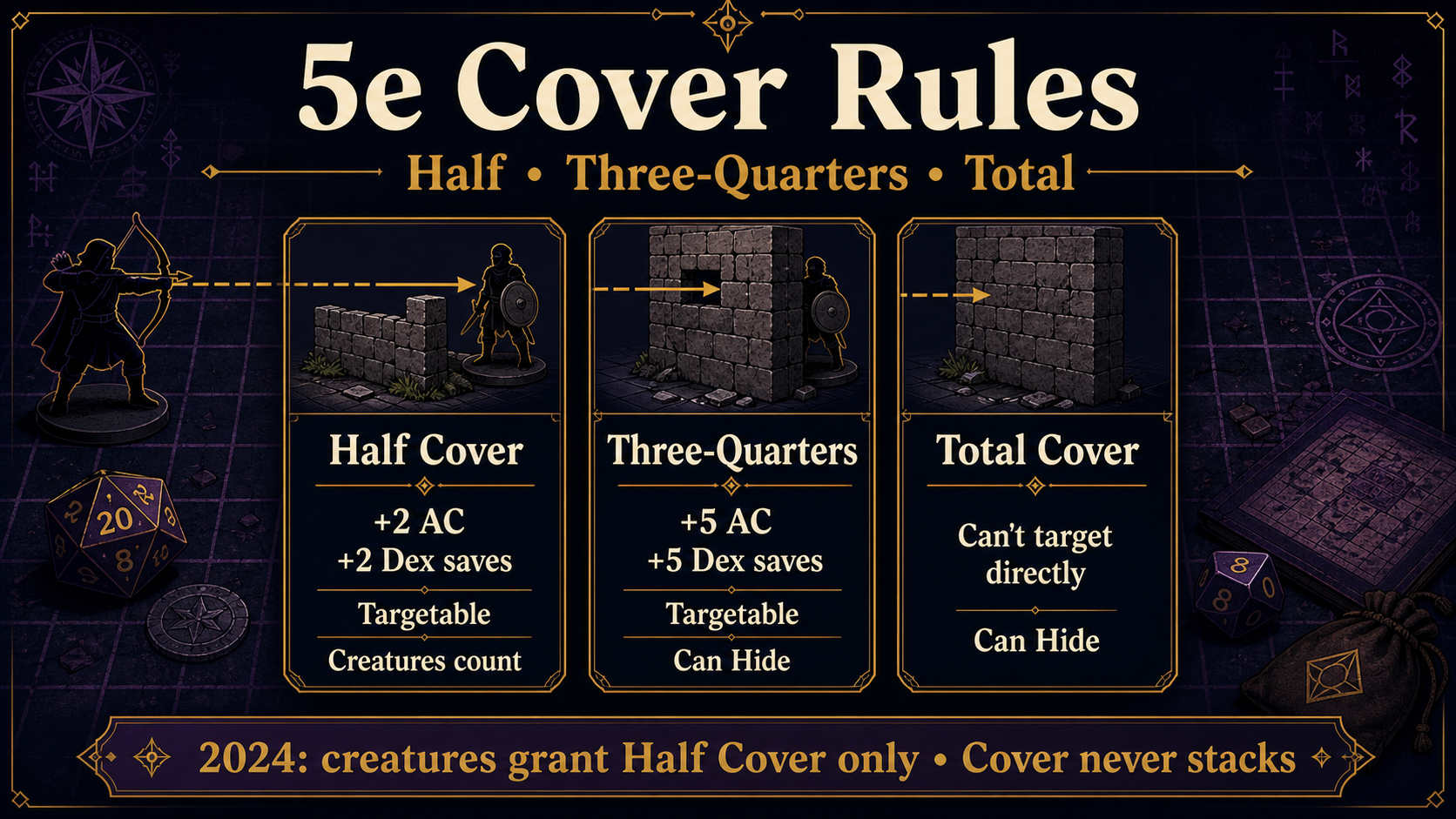
Cover has three degrees. Each one makes a target harder to hit. This table is the whole rule in miniature:
| Degree of cover | Benefit | Granted by | Targetable? |
|---|---|---|---|
| Half Cover | +2 to AC and Dexterity saving throws | Another creature, or an object covering at least half the target | Yes |
| Three-Quarters Cover | +5 to AC and Dexterity saving throws | An object covering at least three-quarters of the target | Yes |
| Total Cover | Can't be targeted directly | An object covering the whole target | No |
What counts as cover
Two rules govern cover before you ever pick a degree. The 2024 System Reference Document (SRD 5.2) states them in the combat chapter:
Walls, trees, creatures, and other obstacles can provide cover, making a target more difficult to harm. As detailed in the Cover table, there are three degrees of cover, each of which gives a different benefit to a target.
A target can benefit from cover only when an attack or other effect originates on the opposite side of the cover. If a target is behind multiple sources of cover, only the most protective degree of cover applies; the degrees aren't added together. For example, if a target is behind a creature that gives Half Cover and a tree trunk that gives Three-Quarters Cover, the target has Three-Quarters Cover.
D&D 2024, SRD 5.2, "Cover"
So two principles do a lot of work:
- Cover only protects against attacks from the other side of it. The obstacle has to sit between the attacker (or the spell's point of origin) and the target. The wall a goblin hides behind does nothing against the rogue who flanked around it.
- Cover does not stack. Hiding behind a friendly fighter and a tree trunk does not give you +7. You take the single best degree and ignore the rest. The +2 and +5 are never added together.
Who decides whether an obstacle counts? The Game Master. There is no mandatory grid-geometry rule in the core books. A common table shortcut is to trace an imaginary line from the attacker to the target: if the line is partly interrupted by an obstacle, that's cover, and how much of the target it hides sets the degree. Treat that as a heuristic, not a rule, and let the GM make the call.
Half Cover: +2 to AC and Dexterity saves
The 2024 Cover table defines Half Cover as protection from "another creature or an object that covers at least half of the target." A target with Half Cover gets +2 to AC and to Dexterity saving throws.
Typical sources: a low wall, a large piece of furniture, a creature, a windowsill, a battlement merlon, a thin tree. The most argued-about source is the last word in the definition: another creature.
GM ruling: creatures grant cover, friend or foe. If a creature stands between your attacker and your target, the target has Half Cover. It does not matter whether the creature in the way is your ally or your enemy. Fire a longbow at a goblin standing behind another goblin and the target goblin has +2 AC. This catches a lot of tables out, and it cuts both ways: your own front line can be handing the enemy archer cover.
Three-Quarters Cover: +5 to AC and Dexterity saves
The 2024 Cover table defines Three-Quarters Cover as "an object that covers at least three-quarters of the target." A target with Three-Quarters Cover gets +5 to AC and to Dexterity saving throws.
Classic sources are an arrow slit, a portcullis, a thick tree trunk, or a creature firing from a doorway with only a head and shoulder exposed. +5 is a large swing. It is the difference between a level-appropriate monster hitting a target half the time and barely hitting it at all, so this degree is worth getting right.
Note one word in that definition: object. A creature cannot grant Three-Quarters Cover. We will come back to why that wording matters when we compare editions.
Total Cover: can't be targeted at all
Total Cover is granted by "an object that covers the whole target." The 2024 Rules Glossary is blunt about the effect:
Cover provides a degree of protection to a target behind it. There are three degrees of cover, each of which provides a different benefit to a target: Half Cover (+2 bonus to AC and Dexterity saving throws), Three-Quarters Cover (+5 bonus to AC and Dexterity saving throws), and Total Cover (can't be targeted directly). If behind more than one degree of cover, a target benefits only from the most protective degree.
D&D 2024, SRD 5.2, Rules Glossary, "Cover"
A creature behind Total Cover is not "hard to hit." It is off the menu. You cannot make an attack roll against it and you cannot point a single-target spell at it, because you have no clear path to it.
GM ruling: area effects still reach total cover. Total Cover blocks direct targeting, not every spell. An area-of-effect spell has a point of origin, and the 2024 Areas of Effect rule says: "If all straight lines extending from the point of origin to a location in the area of effect are blocked, that location isn't included in the area of effect. To block a line, an obstruction must provide Total Cover." So if a wizard drops a Fireball's point of origin around the corner from the creature behind Total Cover, and an unblocked line reaches that creature's space, it is caught in the blast. Total Cover protects against the archer; it does not protect against the explosion that goes off next to you.
Cover and saving throws: the part people miss
Read the benefit again: "+2 bonus to AC and Dexterity saving throws." That second clause matters. Cover also boosts a saving throw, and only one: Dexterity.
- A creature behind a low wall gets +2 (or +5) to its Dexterity save against Fireball, Lightning Bolt, and any other effect that calls for a Dex save. That is a real, frequently forgotten bonus.
- Cover does nothing for Constitution, Wisdom, Strength, Intelligence, or Charisma saves. A wall does not help you resist a Hold Person (Wisdom) or a poison (Constitution).
- The AC bonus applies to every attack roll against the target, including spell attack rolls such as Fire Bolt or Guiding Bolt, not just weapon attacks.
2024 vs 2014: what actually changed
The honest answer is anticlimactic: cover did not meaningfully change in the 2024 revision. Three degrees, +2, +5, can't-be-targeted, no stacking, must originate on the far side: all identical to the 2014 rules. The worked example in the rulebook is even the same one (a creature giving Half plus a tree trunk giving Three-Quarters resolves to Three-Quarters). If you have run cover for a decade, keep running it.
What changed is wording and presentation. Four things are worth knowing.
1. The definitions moved into a table
In 2014, each degree was defined in a prose paragraph with flavour examples ("a portcullis, an arrow slit, or a thick tree trunk"). The 2024 rules drop most of the examples and put the core definitions in the Cover table, with a column titled "Offered By..." that states, for each degree, exactly what grants it.
2. The thresholds were standardised
The 2014 wording was slightly inconsistent. Half cover needed an obstacle that "blocks at least half" of the target, but three-quarters cover needed one that covered "about three-quarters." The 2024 table makes both read "at least," which removes the fuzzy "about" and gives the GM a firmer line to adjudicate.
| 2014 (SRD 5.1) | 2024 (SRD 5.2) | |
|---|---|---|
| Half cover | "an obstacle blocks at least half of its body" | "an object that covers at least half of the target" |
| Three-quarters cover | "about three-quarters of it is covered" | "covers at least three-quarters of the target" |
| Creatures as cover | Listed only as a half-cover example | Stated as a rule: creatures grant Half Cover only |
| Hiding | GM decides when you can attempt to Hide | Hide action requires Three-Quarters or Total Cover (or Heavily Obscured) |
3. A creature grants Half Cover only, now explicit
This is the most useful clarification. In 2014, a creature appeared only in the list of half-cover examples; the three-quarters and total examples never mentioned creatures, but the book never came out and said a creature was capped at Half. That left a genuine table argument: could a Gargantuan dragon body-blocking a doorway grant you Total Cover?
The 2024 "Offered By..." column settles it. Half Cover is offered by "another creature or an object." Three-Quarters and Total Cover are each offered by "an object." A creature is not an object. So in the 2024 rules, a creature can grant at most Half Cover, no matter how enormous it is. Hiding behind the barbarian is +2, never +5, never untargetable.
4. The Hide action now keys off cover
The fourth change is the one that actually reaches the table. In 2014, the Hide action had no cover requirement; the rules just said the GM decides when hiding is possible. In 2024, the Hide action spells it out:
With the Hide action, you try to hide yourself. To do so, you must succeed on a DC 15 Dexterity (Stealth) check while you're Heavily Obscured or behind Three-Quarters Cover or Total Cover, and you must be out of any enemy's line of sight.
D&D 2024, SRD 5.2, "Hide"
So Three-Quarters and Total Cover picked up a second job in 2024: they are now the gate for stealth. Half Cover does not let you Hide. That makes the difference between half and three-quarters matter far more than it used to. It is no longer just +3 AC; it is the line between "can attempt to vanish" and "cannot."
Five rulings to keep in your back pocket
- Peeking out to attack. A creature that is fully behind Total Cover, then steps out or leans around to make its own attack, generally exposes itself for that attack. Many GMs rule it has the cover relevant to how much of it is now showing (often Half or Three-Quarters), and full Total Cover only while it stays fully hidden.
- Your own minions block your shots. Because creatures grant Half Cover, a wall of your own summoned wolves between your archer and the enemy gives that enemy +2 AC. Position matters.
- Prone is not cover. The Prone condition has its own rules (advantage for melee attackers, disadvantage for ranged attackers beyond 5 feet). It does not grant a cover bonus, and it does not stack with cover as cover.
- Cover beats some feats, but not all. Certain options let ranged attackers ignore Half and Three-Quarters Cover (the Sharpshooter feat is the well-known one). Check the exact text of the feature in play; if it does not name cover, cover still applies.
- Spells can hand out cover. Cover is not only terrain. Blade Barrier, for example, "provides three-quarters cover to creatures behind it." When a player asks how to get cover in the open, the answer is sometimes a spell.
Frequently asked questions
Does a creature provide cover in D&D 5e?
Yes. A creature standing between the attacker and the target grants Half Cover (+2 to AC and Dexterity saving throws), whether that creature is an ally or an enemy. In the 2024 rules a creature can never grant more than Half Cover, no matter how large it is.
Does cover apply to spell saving throws?
Cover gives a bonus to AC and to Dexterity saving throws only. So it helps against the Dexterity save from Fireball, but it does nothing for Constitution, Wisdom, Strength, Intelligence, or Charisma saves. The AC bonus also applies against spell attack rolls such as Fire Bolt.
Can you target a creature behind total cover?
No. A target with Total Cover cannot be targeted directly by an attack or a spell. An area-of-effect spell can still reach it, but only if an unblocked straight line runs from the spell's point of origin to the target's space.
Do you need cover to hide in the 2024 rules?
Yes. The 2024 Hide action requires you to be Heavily Obscured or behind Three-Quarters Cover or Total Cover, and out of every enemy's line of sight. Half Cover is not enough to take the Hide action.
Does cover work against melee attacks?
Yes, by the rules as written. Cover does not distinguish melee attacks from ranged attacks. If an obstacle sits between the attacker and the target, the cover bonus applies. It simply comes up less often because melee attackers usually move into a space with a clear line to the target.
Did the cover rules change in the 2024 Player's Handbook?
Not mechanically. The three degrees and the +2 / +5 / cannot-be-targeted benefits are identical to 2014. The 2024 wording is tighter: it puts the definitions in a table, standardises the thresholds to "at least," and makes explicit that a creature grants only Half Cover. The bigger shift is indirect: the 2024 Hide action now keys off Three-Quarters and Total Cover.
Stop flipping pages for this
Cover is a thirty-second lookup that somehow eats two minutes of table time, every session, because the wording lives in three different places: the combat chapter, the Rules Glossary, and the Hide action. The answer should arrive before the argument does.
LorePanic searches the full rulebook (plus your own adventure PDFs, homebrew, and campaign notes) and quotes the exact passage with a citation, so you can rule and move on. You can try the rules side right now with our free SRD search, no account needed, or read how it compares to asking ChatGPT the same questions.
Settle the rules question before the moment passes.
Try Free SRD SearchRules text quoted from the System Reference Document 5.1 and System Reference Document 5.2, © Wizards of the Coast LLC, available under the Creative Commons Attribution 4.0 International License. This article is unofficial fan content and is not endorsed by Wizards of the Coast.